Married in the United States? In Brazil, you are still single.
Your American marriage certificate is valid in the United States, but it does not change your marital status in Brazil. For that, the marriage must be registered with the Brazilian consulate and then with a Brazilian registry office (cartório). Cartório BR takes care of both stages, and you follow every step from home.
- Consulate and registry office, one service
- For Brazilian or American spouses
- No need to travel to Brazil
Married in the United States, single in Brazil.
When you marry in the United States, the county issues your marriage certificate. In the U.S., that is all you need for joint tax returns, insurance, benefits and a name change with Social Security.
In Brazil, that same certificate is not enough on its own. The marriage only appears in the Brazilian civil registry once it has been transcribed by a registry office, which, as a rule, comes after registration at the consulate.
Until then, as far as Brazilian authorities are concerned, you are still single. Your new last name cannot go on your passport. Your spouse does not appear as an heir. The deed to a property bought after the wedding does not state the marital property regime.
Many people only find out when they already need the document.
Brazil recognizes marriages performed abroad, but a marriage only has full legal effect once it is registered.
Resolution No. 155/2012 of Brazil's National Council of Justice (CNJ) says so in plain terms: the transcription by the First Civil Registry Office "is intended to give publicity and effect to the marriage, already recognized as valid under Brazilian law, allowing it to produce full legal effects within the national territory" (Article 13, § 11).
One marriage, three certificates: American, consular and Brazilian.
American marriage certificate. Issued by the county where you were married, it proves your marriage in the United States. For Brazil, it is the starting point, not the final document.
Next come the consular certificate and the Brazilian certificate, explained below. There is also a direct route: taking the American certificate straight to the registry office, without going through the consulate. In that case, the certificate needs an apostille and a sworn translation, and the Brazilian certificate is issued without a marital property regime. Cartório BR reviews your case and recommends the best route.
Consular certificate.
Final Brazilian certificate.
Who needs this service: Brazilians who married in the United States.
Your spouse is also Brazilian
Your marriage needs to be on record in Brazil, with the marital property regime defined. Without it, any property either of you buys in Brazil is registered as if the buyer were single.
Your spouse is American or from another country
Once the marriage is registered, your foreign spouse is listed in the Brazilian civil registry. That allows them to apply for a family reunification visa, be added as a dependent and prove their status as a spouse in a probate proceeding in Brazil.
You changed your last name when you married
Your Brazilian passport, ID card (RG), taxpayer number (CPF) and other Brazilian records only show your new name once the marriage is registered. Until then, the name on your passport does not match the one on your driver's license.
You plan to buy, sell or inherit property in Brazil
Property deeds, probate, division of assets and powers of attorney between spouses all require the correct marital status on record at the registry office.
You divorced in the United States without ever registering the marriage
In Brazil, the marriage must be registered first; only then can the divorce be annotated (formally noted) on the certificate. If the divorce was uncontested and dealt only with ending the marriage, the registry office handles both at once. If the decree also ruled on custody, support or division of property, or if the divorce was contested, it must first be recognized (validated) by Brazil's Superior Court of Justice (STJ). The team reviews the decree and tells you which situation applies to you.
Registration becomes urgent at the worst possible moment: a property sale, an inheritance or a divorce.
Years after the wedding, Brazil asks for proof. The real estate agent needs the marriage certificate for the deed. The probate attorney asks which marital property regime applies. The consulate asks for the registered certificate for your spouse's visa. The registry office turns down the divorce because no marriage is on record.
That is when people discover they only have the American certificate and that, for Brazil, they are still single. Then they have to chase the apostille, the translation, the consulate and the registry office all at once, with someone waiting on the other end.
Done ahead of time, registration takes a few weeks and uses documents you already have at home. Done in a rush, it is the same process, only now in the middle of a negotiation, a death in the family or a separation.
Without your marriage registered in Brazil, these can be held up:
- Changing your last name on your passport and ID card (RG)
- The correct marital status on your CPF and other records
- Buying and selling property in Brazil
- Defining the couple's marital property regime
- Probate and your spouse's inheritance
- The family reunification visa for a foreign spouse
- Adding your spouse as a dependent
- Divorce and division of assets in Brazil
The law requires a marriage performed abroad to be registered, and the CNJ resolution explains how.
Article 1,544 of the Brazilian Civil Code provides that the marriage of a Brazilian citizen performed abroad, before local authorities or Brazilian consuls, must be registered within 180 days of the return of one or both spouses to Brazil, at the registry office of their domicile or, if there is none, at the First Civil Registry Office of the capital of the state where they take up residence.
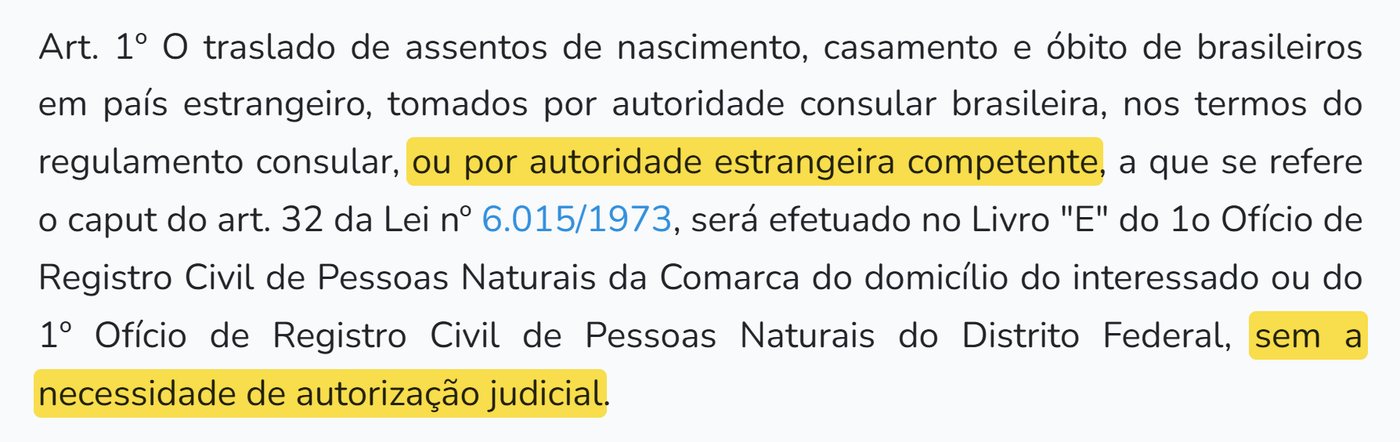
Resolution No. 155 of July 16, 2012, of Brazil's National Council of Justice (CNJ), sets out the procedure. Article 1 states that marriage records of Brazilians abroad, made by a Brazilian consular authority or by a competent foreign authority, are transcribed into Book "E" of the First Civil Registry Office of the judicial district (comarca) where the applicant is domiciled, or of the Federal District, without a court order.
Article 13 lists what the registry office requires to transcribe the marriage: the consular certificate, or the foreign certificate legalized and translated by a sworn translator (item a); the Brazilian spouse's birth certificate, or the certificate of a prior marriage with proof that it was dissolved (item b); a statement or proof of domicile in the judicial district or, for those with no domicile in Brazil, a filing with the First Civil Registry Office of the Federal District (item c); and an application signed by one of the spouses or by an attorney-in-fact (item d).
On the marital property regime. Article 13, § 2, is clear: if the marriage record made by a Brazilian consular authority or by a foreign authority does not state the property regime, that does not prevent the transcription. That is why a direct transcription of the American certificate is issued with no property regime defined. Paragraph 3 allows the regime to be annotated later, without a court order, upon supporting documentation, following the procedure detailed in CNJ Resolution No. 583/2024. Paragraph 4 requires the certificate to note that Article 7, § 4, of the Introductory Law to the Rules of Brazilian Law (LINDB) applies, which means the property regime follows the law of the country where the couple was domiciled. Paragraph 5 covers prenuptial agreements made in the United States: with an apostille and a sworn translation, the agreement must be registered with a Brazilian Registry of Deeds and Documents (Cartório de Títulos e Documentos) before the transcription. The apostille replaces consular legalization because Brazil and the United States are both parties to the Apostille Convention (Decree No. 8,660/2016), as provided in Article 2, § 3, of the resolution itself.
On the name. Paragraphs 6 and 7 of Article 13 state that the absence of the name adopted after the marriage does not prevent the transcription: the registry office keeps the maiden names and allows the new name to be annotated later, with proof that it was changed under the law of the country of domicile.
In practice, what causes delays is not the law but the paperwork: a certificate that is too old or a missing apostille. Cartório BR reviews everything before each submission.
The marriage of a Brazilian citizen performed abroad, before local authorities or Brazilian consuls, must be registered within 180 days of the return of one or both spouses to Brazil, at the registry office of their domicile or, if there is none, at the First Civil Registry Office of the capital of the state where they take up residence.
Marriage records of Brazilians abroad, made by a Brazilian consular authority or by a competent foreign authority, are transcribed into Book "E" of the First Civil Registry Office of the judicial district where the applicant is domiciled, or of the Federal District, without a court order.
Allows the marital property regime to be annotated later, without a court order, upon supporting documentation.
Covers the direct annotation of a foreign divorce at the registry office.
Brings into force in Brazil the Apostille Convention, which replaces consular legalization between member countries such as Brazil and the United States.
What you need to send
Consular registration: Brazilian spouse's documents
- Proof of identity: a valid Brazilian passport or a Brazilian ID card (RG) issued less than 10 years ago
- Civil status certificate: a birth certificate, or a marriage certificate annotated with the divorce, issued within the last 6 months
- Proof of name change, if the name was changed after the marriage
- CPF number
Consular registration: American spouse's documents
- American birth certificate (the long-form version if the spouse's or parents' names are abbreviated)
- Valid photo ID: U.S. passport, driver's license or state ID
- Marital status declaration: Cartório BR prepares the text and the spouse signs it before a local notary public
- Proof of name change, if any
- Proof of divorce from any prior marriage, if applicable
Consular registration: documents from the couple
- American marriage certificate
- Recent proof of address
Transcription of the consular certificate: Brazilian spouse's documents
- Brazilian proof of identity: a valid passport or ID card (RG)
- Certificate of civil status prior to the marriage
- CPF number
- Recent proof of address
- The original consular marriage certificate, which stays with the registry office and is not returned
Direct transcription of the American certificate, without the consulate: Brazilian spouse's documents
- Proof of identity: a valid Brazilian passport or a Brazilian ID card (RG) issued less than 10 years ago
- Brazilian civil status certificate
- American marriage certificate
- Proof of address
- CPF number
From the American county to the Brazilian registry office, without leaving the United States.
Review of your case
You get in touch, and the team looks at your spouse's nationality, whether there was a name change, any prior divorce and the marital property regime. Based on that, it recommends the best route: registration at the consulate followed by transcription, or direct transcription of the American certificate.
Document submission and review
You send your documents, and Cartório BR checks each one, tells you what needs to be updated and prepares the marital status declaration for your American spouse.
Registration at the Consulate General of Brazil in San Francisco
Cartório BR prepares the application and tracks every step at the consulate, which registers the marriage and issues the consular certificate.
Transcription in Brazil and delivery of your certificate
The original consular certificate is sent to Brazil and transcribed by the First Civil Registry Office. You receive your Brazilian marriage certificate in both paper and digital form.
Why register your marriage with Cartório BR?
People who know the requirements inside and out
Francisco Harto has lived in the United States since 2016 and, since 2017, has volunteered at the Brazilian consulate's mobile consular missions. He knows what the consulate asks for, what it rejects and what gets an application sent back.
Two stages, one team
Consular registration and transcription involve two authorities, two sets of requirements and two countries. Cartório BR coordinates both stages, with teams in the United States and in Brazil, and you deal with a single person.
A hassle-free process for American spouses
The team prepares the marital status declaration the consulate requires from the foreign spouse; all they have to do is sign it before a notary. For more than five years, Cartório BR has served Brazilians in the United States, mainly in Seattle, Portland and San Francisco, and most of the marriages it handles are between Brazilians and Americans.
Documents checked before they are sent
A birth certificate that is too old, a name that does not match, a prior divorce that was never annotated: the team finds the problem before the consulate does.
Mistakes that get a marriage registration sent back.
Assuming the American certificate, on its own, changes your marital status in Brazil.
Sending a Brazilian birth certificate issued more than 6 months ago.
Having a prior marriage in Brazil without the divorce annotated on the certificate.
Using your married name on your U.S. passport and your maiden name on your Brazilian one, without proof of the name change.
Taking the American certificate to the registry office without an apostille and a sworn translation.
Transcribing directly at the registry office and only finding out at the property closing that the certificate was issued with no marital property regime.
Failing to register a prenuptial agreement signed in the United States (apostilled and with a sworn translation) with a Registry of Deeds and Documents in Brazil before the transcription.
Two stages, two timelines.
The consulate stage depends on the schedule of the Consulate General of Brazil in San Francisco and on the details of your case. The team gives you an estimate at the very first review. Once the consular certificate reaches the registry office, the transcription in Brazil takes 30 to 45 days on average, depending on the registry office and any additional requirements. The Civil Code sets a 180-day period for registering a marriage performed abroad, counted from the return of one of the spouses to Brazil. If you still live in the United States, that period has not started yet. Still, there is no reason to wait: the day you need the document will come without warning.
Frequently asked questions
Yes, it is valid. But to have full legal effect in the country (marital status, name, property, inheritance, divorce), it must be registered: usually first with the consulate and then by transcription at a Brazilian registry office.
No. Registration at the consulate is done here in the United States, and the transcription is handled by the Cartório BR team in Brazil. You send your documents, track the progress and receive your Brazilian certificate without traveling.
Very little. The American spouse sends their birth certificate, a photo ID and, if applicable, proof of name change and the prior divorce document. Cartório BR drafts the marital status declaration, and the spouse only needs to sign it before a notary. They do not need to go to the consulate or to Brazil.
Yes. The certificate needs an apostille and a sworn translation, and the transcription is issued with no marital property regime defined. This route settles your marital status and your name; the property regime takes one more step. The team recommends the best option for your case.
With consular registration, the property regime can be declared. With direct transcription of the American document, the Brazilian certificate is issued with no regime, and the registry office notes that the law of the country where the couple lived applies. The regime can be annotated later, without going to court, with the documents required by CNJ Resolution No. 155/2012. When the team files the request on your behalf, a power of attorney is also required.
Only after registration. Once the marriage is registered and your last name is updated on the certificate, you can apply for a new passport. Until then, your Brazilian passport keeps your previous last name.
This can be fixed. If the divorce was uncontested and dealt only with ending the marriage, Cartório BR handles the transcription of the marriage and the annotation of the divorce in the same process. You send the American marriage certificate, a complete copy of the divorce decree (apostilled and with a sworn translation) and your Brazilian documents. If the decree also ruled on custody, support or division of property, or if the divorce was contested, it must first be recognized by Brazil's Superior Court of Justice (STJ). The team reads the decree and tells you which situation applies to you.
It depends on the stage: the consulate works on its own schedule, and the team gives you an estimate when it reviews your case. The transcription in Brazil usually takes 30 to 45 days from the date the consular certificate reaches the registry office.
No. Cartório BR is a private document services company: it is not a consulate, a registry office or a government agency. The consulate registers the marriage and the registry office performs the transcription; Cartório BR prepares, guides and follows every stage.
Make your marriage count on both sides of the border.
If you married in the United States, whether to a Brazilian or to an American, and have not registered the marriage, Brazil does not know about it yet. Cartório BR guides you through both stages, at the consulate and at the registry office, and delivers your Brazilian certificate, ready to use for your passport, a property transaction, your spouse's visa or whatever else you need.
Remote service for Brazilians in the United States, with a team in both countries.