Was your child born in the US? Registration secures their Brazilian citizenship.
Under Brazil's Constitution, a child born abroad to a Brazilian father or a Brazilian mother is a natural-born Brazilian citizen, provided the birth is registered with a competent Brazilian authority. Cartório BR prepares everything for that registration, whether at the consulate or directly with a civil registry office in Brazil. We also help former Brazilian citizens get their citizenship back.
- Registration at the consulate or at a registry office in Brazil
- A team in the United States and in Brazil
- Remote service anywhere in the US
In the United States, your child has every document. In Brazil, they have none yet.
A child is born in an American hospital and goes home with a state birth certificate and a Social Security number. Then comes the US passport, and the family feels that everything is in order.
On the Brazilian side, however, nothing has happened. There is no birth record, no Brazilian certificate, and no CPF (Brazilian taxpayer ID). Nationality is the child's right, but it only appears in Brazilian documents once someone takes care of the registration.
This registration can be done in one of two ways: at the Brazilian consulate, or directly at the First Civil Registry Office (1º Ofício) in Brazil, based on the US birth certificate. The document list depends on the child's age and the parents' situation.
The worst time to find this out is right before a trip, when the airline asks for the Brazilian passport. Or in the middle of probate in Brazil, when the heir does not appear on any record.
Without the registration, the child has no Brazilian documents.
A Brazilian passport, a CPF, a Brazilian ID card, school enrollment in Brazil, inheritance, survivor benefits, and any procedure at a registry office all depend on a Brazilian birth certificate. You may have the US certificate in hand and still be unable to obtain any of these until the registration is done.
Two ways to register your child, plus a path back for former citizens
Birth registration is what makes a child born abroad officially exist in the eyes of Brazil. With it, the child receives a Brazilian birth certificate and a CPF, and can then obtain a passport and every other Brazilian document.
Path 1: registration at the consulate. The parents go to the Brazilian consulate with the US birth certificate and their own documents. For families in our region, that is the Consulate General of Brazil in San Francisco or a mobile consulate (missão itinerante). The consulate records the birth and issues the consular birth certificate, which already includes the child's CPF. For children under 12, the registration is processed together with the passport. From age 12, two witnesses are required. The consular certificate must later be transcribed at the First Civil Registry Office to have full legal effect in Brazil.
Path 2: direct transcription of the US birth certificate. When the family cannot get to the consulate, the US birth certificate can be transcribed directly at a Brazilian registry office. For that, it needs an apostille, a sworn translation, and proof that one of the parents is Brazilian. On this path, the Brazilian certificate carries a note: after age 18, confirmation of citizenship depends on living in Brazil and filing an election of nationality (opção) with the Federal Courts. Cartório BR's service covers the apostille, the translation, the process in Brazil, and two copies of the Brazilian birth certificate.
Path 3: reacquisition of citizenship, for those who were once Brazilian and no longer are. The request is filed with Brazil's Ministry of Justice, together with the Brazilian birth certificate, the document proving the loss, and the foreign naturalization certificate. Once approved, the reacquisition is formally recorded (averbada) on the birth certificate. The requirements are set by the Ministry itself. The official service page still asks for proof that the reason for the loss no longer applies, and our team checks the current guidance before preparing your request.
A birth certificate issued by the US state where the child was born.
A Brazilian birth record, with a birth certificate and a CPF.
Who this service is for
A child under 12 with no Brazilian registration yet
This is the simplest case. The parents go to the consulate with the US birth certificate and their own documents, and the registration is completed together with the child's passport. Cartório BR puts together the list, checks every document, and prepares the application for the day of the appointment.
A child between 12 and 16
Registration at the consulate is still possible, with two additional requirements: the teenager presents their own photo ID, and you must bring two adult witnesses with full legal capacity, preferably Brazilian, who are not the parents. This is the age group in which many families arrive at the consulate with only half the list.
A child over 16, or yourself, if you were born in the US to a Brazilian parent
Registration at the consulate can be requested at any age. The person presents the US birth certificate and a photo ID. The list is the same as for the previous age group, including the two witnesses.
Families who cannot get to the consulate
Getting to the consulate is not always possible, whether because of distance, work schedules, or because no mobile consulate is coming to your city. In that case, the US birth certificate can be transcribed directly at a Brazilian registry office, and Cartório BR handles the apostille, the translation, and the process in Brazil. The Brazilian certificate is issued with a note about electing Brazilian nationality after age 18. Our team explains what that means before you decide.
Former Brazilian citizens who lost their nationality
If you became a US citizen and the loss of your Brazilian citizenship was formally declared, you can apply to become Brazilian again. The request goes to the Ministry of Justice, which sets the requirements for each case. Once approved, the reacquisition is formally recorded (averbada) on your Brazilian birth certificate.
A missing registration shows up at the airline counter, at school, or in probate.
While the family lives in the United States, the US birth certificate covers everything. The Brazilian registration seems like a detail that can wait. And it does wait, for years.
Then comes the first trip to Brazil with the child, and the family learns that without the Brazilian certificate, the passport cannot be issued. Or a grandparent passes away there, and the grandchild does not appear on any record, so they cannot be included in the estate. Or the family decides to spend a year in Brazil, and the school asks for the child's CPF and birth certificate.
At each of these moments, registration is still possible. But it has to be done in a rush, with the consulate fully booked, a document expired, and the tickets already purchased.
Done ahead of time, the registration is a scheduled appointment and a document list checked in advance. Done later, it involves the same steps, only with the rest of your life on hold.
Without the registration, these may be held up:
- The child's Brazilian passport
- The CPF and the Brazilian ID card
- School enrollment in Brazil
- Including the child in probate and the division of an estate
- Survivor benefits after the death of a Brazilian parent
- A bank account in Brazil in the child's name
- Procedures at registry offices in Brazil
- Transcription of the consular certificate at a Brazilian registry office
The Constitution guarantees your child's citizenship. Registration puts that right into effect.
Brazil's Federal Constitution, Article 12, item I, subparagraph (c), states that natural-born Brazilians include those born abroad to a Brazilian father or a Brazilian mother, provided they are registered with a competent Brazilian authority, or that they come to live in Brazil and, at any time after reaching adulthood, elect Brazilian nationality. In other words, the right is born with the child, and registration puts it into effect.
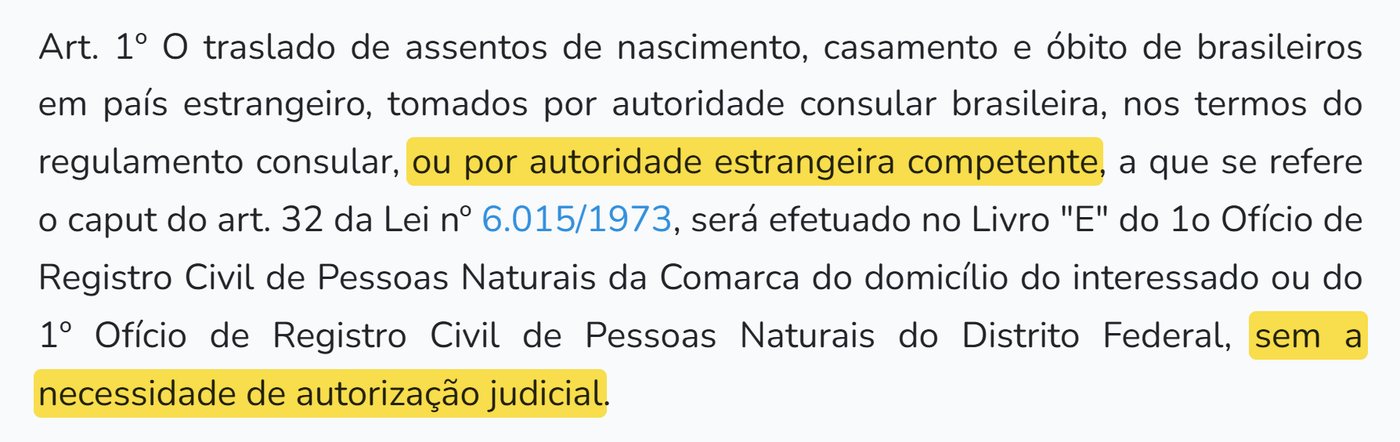
Registration at the consulate counts as registration with a competent Brazilian authority. When the family prefers a registry office, Article 1 of Resolution No. 155 of July 16, 2012, of Brazil's National Council of Justice (CNJ) applies: birth records of Brazilians in a foreign country, made by a consular authority or by a competent foreign authority, are transcribed in Book "E" of the First Civil Registry Office in the judicial district where the applicant lives, or in the Federal District, with no need for a court order. Article 7 lists what must be submitted to transcribe a consular certificate. Article 8 sets out what is required for a foreign certificate that did not go through the consulate: a legalized certificate (today, an apostilled one, under the Apostille Convention, enacted in Brazil by Decree No. 8,660/2016, and under Article 2, paragraph 3, of the Resolution itself), a sworn translation, a statement of residence or proof of address, a written application, and proof that one of the parents is a Brazilian citizen. When there is no residence in Brazil, the transcription goes to the First Civil Registry Office of the Federal District. Article 9 provides that the transcription may be requested at any time.
The Resolution also contains a detail that Cartório BR explains before you choose your path: on a certificate transcribed from a consular registration, the registry office notes that the child is a natural-born Brazilian (Article 7, paragraph 1). On a transcription made directly from the US certificate, without going through the consulate, the registry office notes that confirmation of nationality depends on living in Brazil and electing Brazilian nationality before the Federal Courts after reaching adulthood (Article 8, paragraph 1). Both paths produce a Brazilian certificate; only the note differs. The election may be made at any time through a proceeding in the Federal Courts, under Law No. 13,445/2017 (Brazil's Migration Law), Article 63.
Since Law No. 14,534 of January 11, 2023 (Article 1), the CPF has been the single number sufficient to identify a citizen in public service databases, and it must appear on the birth certificate. That is why the consulate already enrolls the child in the CPF at the time of registration. And under CNJ Resolution No. 155/2012, Article 6-A (added in 2021), the registry office may record the CPF on the transcription free of charge.
For those who lost their nationality, the rule changed in 2023. Under Constitutional Amendment No. 131/2023, Article 12, paragraph 4, item II, of the Constitution now provides that loss of nationality is declared only when Brazilians themselves expressly request it before a competent Brazilian authority. Acquiring another nationality no longer results, on its own, in the loss of Brazilian nationality. And paragraph 5, added by the same Amendment, guarantees that those who renounced it may reacquire their original Brazilian nationality, as provided by law.
Law No. 13,445/2017, Article 76, states that Brazilians who lost their nationality may reacquire it once the reason for the loss no longer applies, in the manner set by the competent body of the Executive Branch. That is why the Ministry of Justice sets the requirements, and the official service page (gov.br/pt-br/servicos/readquirir-nacionalidade-brasileira) still asks for proof of this.
Natural-born Brazilians include those born abroad to a Brazilian father or a Brazilian mother, provided they are registered with a competent Brazilian authority, or that they come to live in Brazil and, at any time after reaching adulthood, elect Brazilian nationality.
Birth records of Brazilians in a foreign country, made by a consular authority or by a competent foreign authority, are transcribed (traslado) in Book "E" of the First Civil Registry Office (1º Ofício de Registro Civil) in the judicial district where the applicant lives, or in the Federal District, with no need for a court order.
The CPF is the single number sufficient to identify a citizen in public service databases, and it must appear on the birth certificate.
Loss of nationality is declared only when Brazilians themselves expressly request it before a competent Brazilian authority. Those who renounced it may reacquire their original Brazilian nationality, as provided by law.
The election of Brazilian nationality may be made at any time through a proceeding in the Federal Courts (Article 63). Brazilians who lost their nationality may reacquire it once the reason for the loss no longer applies, in the manner set by the competent body of the Executive Branch (Article 76).
Required documents
Registration at the consulate: under 12
- The child's original US birth certificate
- Mother's ID: a valid Brazilian passport or a Brazilian ID card (RG) issued less than 10 years ago
- Mother's original civil status certificate: a marriage certificate if the parents are married; otherwise, her birth certificate
- Mother's CPF number
- Father's ID: a valid Brazilian passport or a Brazilian ID card (RG) issued less than 10 years ago
- Father's original civil status certificate: a marriage certificate if the parents are married; otherwise, his birth certificate
- Father's CPF number
- Mother's proof of address and, if different, the father's as well
- If one parent is not Brazilian: that parent's valid passport (for a US citizen, a valid state ID or driver's license is accepted) and their original birth certificate
Registration at the consulate: ages 12 to 16
- The teenager's original US birth certificate
- The teenager's US passport or another foreign photo ID
- The teenager's CPF number, if they already have one
- Mother's ID: a valid Brazilian passport or a Brazilian ID card (RG) issued less than 10 years ago
- Mother's original civil status certificate: a marriage certificate if the parents are married; otherwise, her birth certificate
- Mother's CPF number
- Father's ID: a valid Brazilian passport or a Brazilian ID card (RG) issued less than 10 years ago
- Father's original civil status certificate: a marriage certificate if the parents are married; otherwise, his birth certificate
- Father's CPF number
- Father's proof of address
- If one parent is not Brazilian: that parent's valid passport (for a US citizen, a valid state ID or driver's license is accepted) and their original birth certificate
- Two adult witnesses with full legal capacity, preferably Brazilian, who are not the parents: for each witness, a valid Brazilian passport or a Brazilian ID card (RG) issued less than 10 years ago, plus their CPF number
Registration at the consulate: over 16
- Original US birth certificate of the person being registered
- US passport of the person being registered, or another foreign photo ID
- CPF number of the person being registered, if they already have one
- Mother's ID: a valid Brazilian passport or a Brazilian ID card (RG) issued less than 10 years ago
- Mother's original civil status certificate: a marriage certificate if the parents are married; otherwise, her birth certificate
- Mother's CPF number
- Father's ID: a valid Brazilian passport or a Brazilian ID card (RG) issued less than 10 years ago
- Father's original civil status certificate: a marriage certificate if the parents are married; otherwise, his birth certificate
- Father's CPF number
- Father's proof of address
- If one parent is not Brazilian: that parent's valid passport (for a US citizen, a valid state ID or driver's license is accepted) and their original birth certificate
- Two adult witnesses with full legal capacity, preferably Brazilian, who are not the parents: for each witness, a valid Brazilian passport or a Brazilian ID card (RG) issued less than 10 years ago, plus their CPF number
Direct transcription at a Brazilian registry office
- ID of the Brazilian parent: a valid Brazilian passport or a Brazilian ID card
- Current civil status certificate of the Brazilian parent: birth certificate, marriage certificate, or marriage certificate with the divorce formally recorded on it
- CPF number of the Brazilian parent
- Current proof of address of the Brazilian parent
- A selfie of the Brazilian parent holding that ID
- If one parent is American: that parent's US passport and US birth or marriage certificate
- The child's original US birth certificate, which is retained during the process
Reacquisition of Brazilian nationality
- A recently issued copy of your Brazilian birth certificate
- Proof of the loss of nationality (this may be the birth certificate itself, if the loss is recorded on it)
- Foreign naturalization certificate
- Proof of current address
- CPF number
- Brazilian ID; if it is very old, also send a valid US ID
- Any other documents the Ministry of Justice requires in your case, which we will let you know about during the review
No trip to Brazil. Fully prepared for the consulate. No appearance needed at the registry office.
You contact Cartório BR
You tell us your child's age, whether both parents are Brazilian, and where you live. With that, our team recommends the right path (consulate or registry office) and puts together the exact document list for your case.
You send your documents for review
Our team checks expiration dates, names, the parents' marital status, and the format of the US birth certificate before anything is filed. That review is what keeps you from leaving the consulate without the registration, or from having your request returned by the registry office.
Cartório BR prepares the application
For consular registration, our team books the appointment, prepares the forms, and tells you what to bring on the day, including the witnesses when the child is 12 or older. For direct transcription, we handle the apostille, the sworn translation, and the filing with the First Civil Registry Office in Brazil. For reacquisition, we prepare the request to the Ministry of Justice and follow it through.
You receive the document
With consular registration, the consulate itself issues the certificate, which already includes the child's CPF. With direct transcription, you receive two copies of the Brazilian birth certificate. With reacquisition, you receive the Ministry of Justice's decision and guidance on having it formally recorded (averbada) on the birth certificate.
Why choose Cartório BR?
Someone who knows the consulate from the inside
Francisco Harto has lived in the United States since 2016 and, starting in 2017, has volunteered at Brazilian mobile consulates. He has seen firsthand what gets a family served and what sends a family home without the registration. Cartório BR has served the Brazilian community for more than five years, mainly in Seattle, Portland, and San Francisco.
A team in the United States and in Brazil
For consular registration, our team in the United States prepares the appointment and the documents. For direct transcription and reacquisition, our team in Brazil handles the registry office and the Ministry of Justice. You don't have to figure out on your own whom to contact on either end.
The right list for the right age
Under 12, 12 to 16, over 16, one American parent, married or unmarried parents: each combination changes the documents required. Cartório BR builds the list for your case and checks it item by item before the day of your appointment.
Two paths, honest advice
Our team explains the difference between registering at the consulate and transcribing directly at a registry office, including the note each certificate will carry, so you can decide knowing exactly what each path involves.
Mistakes that delay or prevent registration
Assuming your child's nationality is automatic and requires no registration.
Going to the consulate with the short-form US birth certificate, which does not list the parents' names, instead of the long-form version.
Bringing a Brazilian ID card (RG) issued more than 10 years ago or an expired Brazilian passport.
Using the mother's married name on the child's registration without first registering the marriage at the consulate.
Arriving with a teenager aged 12 or older without the two witnesses, or with the parents themselves as witnesses.
Forgetting the original birth certificate of the non-Brazilian father or mother.
Leaving the registration until the week of the trip, when there are no appointments left at the consulate.
For direct transcription, sending the US birth certificate without an apostille or with a translation done by someone who is not a sworn translator.
The timeline depends on the path
Consular registration: the registration is completed on the day of your appointment at the consulate, which must be booked in advance. How soon you can get an appointment depends on availability at the Consulate General in San Francisco or on when the next mobile consulate comes to your area. Direct transcription at a registry office: we give you the timeline when we review your case, because it combines the apostille, the sworn translation, and the processing at the First Civil Registry Office. Reacquisition of nationality: the Ministry of Justice has no set processing time. In the cases we have followed recently, review and approval took about 100 days on average, not counting the later step of recording the reacquisition on the birth certificate, which is handled separately at the registry office. After the initial review, our team lets you know the next steps and the expected dates for your case. The sooner the process begins, the lower the risk that your trip or the probate case arrives before the document does.
Frequently asked questions
If your child has a Brazilian father or a Brazilian mother, they are entitled to Brazilian citizenship under the Constitution. That right becomes effective through registration with a competent Brazilian authority, such as the consulate. The US birth certificate can also be transcribed directly at a registry office in Brazil. In that case, the Brazilian certificate carries a note: after reaching adulthood, confirmation of citizenship depends on living in Brazil and filing an election of nationality with the Federal Courts. Without the registration, there is no Brazilian birth certificate, no CPF, and no passport.
No. Consular registration is done in the United States, at the consulate or at a mobile consulate. Direct transcription and reacquisition are handled by our team in Brazil, and you follow every step from here.
For consular registration, yes: the parents must appear in person, and the registration cannot be done by mail. Cartório BR prepares everything so that you only have to go once. If you cannot go to the consulate, you can choose direct transcription at a registry office, which does not require you to be present.
Yes. From age 12, the teenager presents their own photo ID, and the registration requires two adult witnesses with full legal capacity, preferably Brazilian, who are not the parents. Over 16, the list stays the same, and registration can be requested at any age, even as an adult.
No. Only one parent needs to be Brazilian. The parent who is not Brazilian presents a valid passport (or, for a US citizen, a valid state ID or driver's license) and their own original birth certificate.
Yes. Since Law No. 14,534/2023, the CPF has been each citizen's single identification number, and the consulate enrolls the child in the CPF at the time of the birth registration. There is no need to apply for the CPF separately.
To get a Brazilian passport at the consulate, yes. To take full legal effect within Brazil, the consular certificate still needs to be transcribed at the First Civil Registry Office. Cartório BR handles that step as well.
Not necessarily. Since Constitutional Amendment No. 131/2023, acquiring another citizenship no longer results in the loss of Brazilian citizenship, which is now declared only at the request of the person concerned. Those whose loss was declared before this change, or who requested it, can apply for reacquisition with the Ministry of Justice, which sets the requirements and has no fixed processing time. The official service page still asks for proof that the reason for the loss no longer applies, and our team checks the current guidance before preparing your request. In the cases we have handled, the review took about 100 days on average, not counting the formal recording (averbação) on the birth certificate.
No. Cartório BR is a private document services company. Official acts are performed by the consulate, the registry offices, and the Ministry of Justice; our role is to advise you, prepare the paperwork, and follow up on every step.
Your child's right already exists. Don't let the registration wait for your next trip.
If your child was born in the United States and does not yet have a Brazilian birth certificate, Cartório BR identifies the right path for their age, puts together the document list, prepares the application, and follows it through until the certificate is issued. And if you lost your Brazilian nationality, our team handles your reacquisition request with the Ministry of Justice.
Remote service for Brazilians in the United States, with a team in both countries.